“You’re going to be left behind”: Why SMEs need to prepare for agentic commerce
Agentic commerce could fundamentally change how customers discover and buy from businesses. Here’s what SMEs need to know about preparing for the next wave of AI-powered payments.
“Technology is rapidly changing and just like all new technology, if you do not get across it and get ahead of it, you’re going to be left behind,” said Shehan Rajakumar, head of SME proposition at AMP Bank.
That was the key message from Mastercard’s The rise of agentic commerce: Trust, payments and the future of buying panel at SmartCompany and Startup Daily’s Growth Summit.
Unlike today’s AI assistants, which typically help users find information or generate content, agentic commerce takes the technology a step further by enabling AI agents to act on a user’s behalf – searching, comparing, making decisions and even completing purchases within agreed guardrails.
Paul Monnington, division president, Australasia at Mastercard, framed this as the next evolution of e-commerce.
“Small businesses should care about agentic commerce because that buying channel is growing massively,” he told the summit. “We have the mobile, we have the internet. We believe the agent channel will grow quite significantly.”
Smarter business news. Straight to your inbox.
For startup founders, small businesses and leaders. Build sharper instincts and better strategy by learning from Australia’s smartest business minds. Sign up for free.
For SMEs, this means future customers may not always arrive through familiar channels such as search engines, social media or online marketplaces. Increasingly, they may be represented by AI agents that search for the best product, supplier, price or service on their behalf.
Baby steps, big gains
While agentic commerce may sound futuristic, the panel suggested its most immediate value for small businesses could be far more practical: reducing admin, improving visibility and helping owners stay on top of cash flow.
“What we’re hearing at MYOB is that the number one point of friction is cash flow,” explained Sally Davies, general manager of solo and embedded finance at MYOB. “It’s the number one reason why businesses fail. 69% of small businesses cite it as a reason that they worry on a daily basis.”
Davies said AI agents could help automate repetitive tasks, support reconciliation and give business owners a clearer view of the money moving in and out of their business.
However, the panel cautioned that SMEs should not rush to hand over entire functions to AI before they understand where the technology can add value.
“I would say don’t launch headlong into this and get an agent to take over your business in entirety. Take baby steps,” Rajakumar explained. “Pick one thing in your business that you want to try and get an agent to look after. Train your agent over time to do that job really well.”
Davies echoed the point, warning that “if you try to automate a process that’s broken, it’s still going to be broken”.
No trust, no transaction
While the panel was optimistic about agentic commerce, it made clear that adoption will depend on trust: what agents are allowed to do, when they need approval and who is accountable if something goes wrong.
Rajakumar pointed to AMP Bank Go’s recent pilot with Mastercard as an example. In the demonstration, a business owner who had booked flights to Melbourne was prompted by an AI agent embedded in their banking app, which asked whether they needed a workspace while they were there. The agent then found a Mastercard Easy Savings Special for a co-working space, sought approval, authenticated the transaction and sent back a confirmation.
“Through the demo and actually going through this with Mastercard I realised the power of agents and agentic commerce, the ability to set up firm guardrails, trust and control,” he said.
Monnington said Mastercard is working to build those controls into the payment process, including registering agents, recording user intent and checking the final purchase matches what was authorised.
Rajakumar said businesses will also need “governance and control”, as well as “auditability and traceability”, so they can understand not only what an agent did, but why it made a decision.
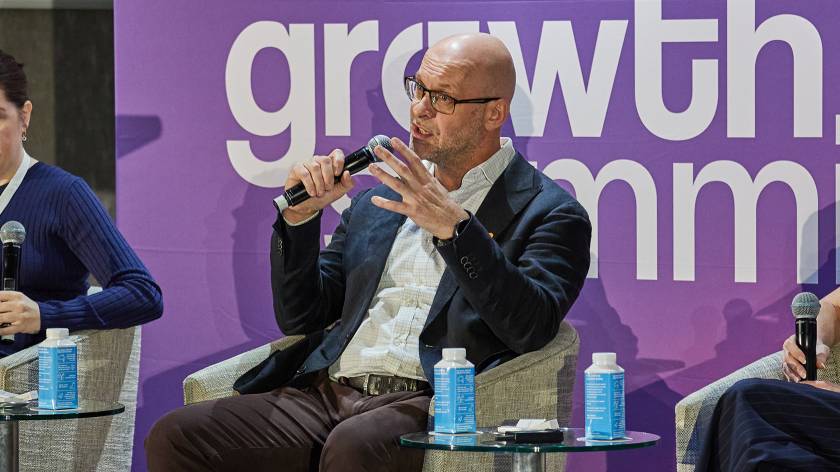
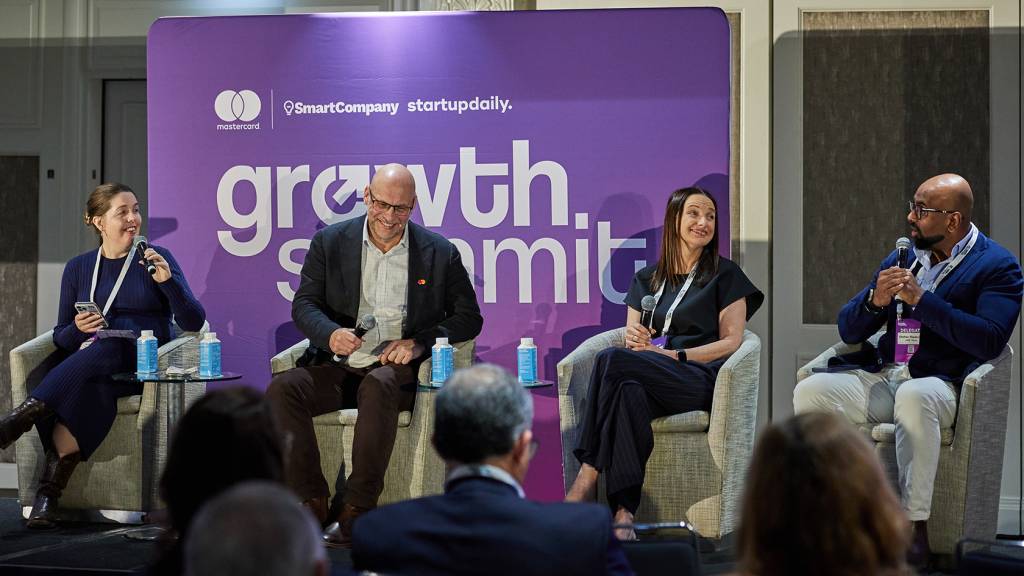
“If you do not get across it and get ahead of it, you’re going to be left behind,” said Shehan Rajakumar during Mastercard’s ‘The rise of agentic commerce’ panel at SmartCompany and Startup Daily’s Growth Summit. Image: Bake Agency.
Data drives discovery
As agentic commerce grows, businesses will need to optimise for AI agents in the same way they once optimised for Google search.
The panel argued that this could create an opportunity to level the playing field for smaller businesses, but only if they prepare their data to optimise an agent’s ability to find, compare and transact with them.
“Preparing the broader set of data around products, including pricing, SKU and description data, while also looking beyond those traditional elements, will become increasingly important,” said Monnington. “Bots will go out there and they won’t just look for price. They may look for loyalty information, price descriptions, delivery times, product reviews.”
In an agentic commerce environment, visibility may depend less on who has the biggest marketing budget and more on who has the clearest, most useful and most machine-readable data.
The rules are still being written
As agentic commerce moves from controlled pilots into real-world business settings, the panel said regulation and industry standards will need to keep pace.
Rajakumar said trust will depend not only on individual businesses setting guardrails, but on banks, regulators, platforms and payment providers working together to create clear rules around how agentic commerce should operate.
“Banks, regulators, platform providers, all need to come together and actually set the rules and the regulations around agentic commerce,” he said.
For business owners, that clarity will be critical. If an AI agent makes a purchase, approves a payment or acts outside its intended parameters, SMEs will need to understand where responsibility sits and what protections are available.
“I think that there is probably a gap in the market at the moment that we really need to give business owners confidence,” Rajakumar said. “This is how it will work, this is where the liability is, this is how you navigate through these changes.”
Monnington said Mastercard is working with standards agencies globally as the ecosystem develops, while Sally Davies, general manager of Solo and Embedded Finance at MYOB, said more industry-level work will be needed to build trust and drive adoption.
“I think there’s still more work to do at an industry level,” Davies said.
Pearl Bendle is a junior copywriter at SmartCo. Media, with a passion for creating stories that connect with audiences. Prior to joining SmartCo. Media she worked with the Foxtel Group and holds a bachelor of communications from the University of Technology Sydney.
Mastercard seeks to help as many Australian retailers as possible, to grow their businesses by embracing all forms of payment to provide customers the choice to make transactions whichever way they want to, with no restrictions.