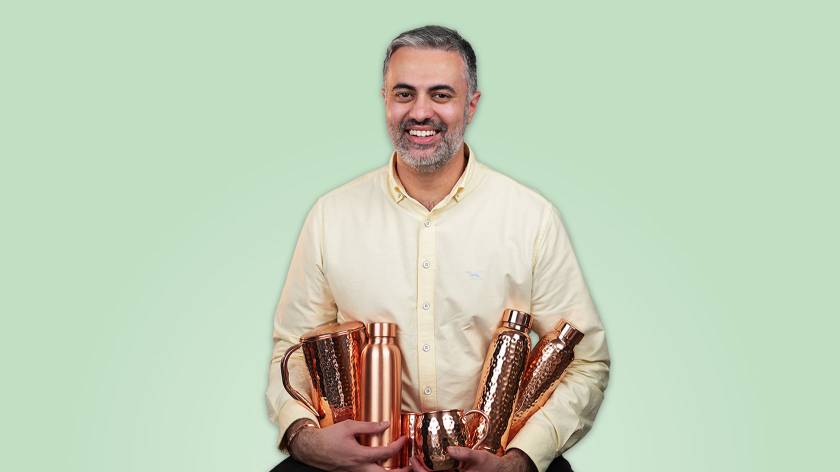
Drinking water from copper vessels has been practised for thousands of years across India, Turkey and the Middle East.
For Shawn Singh, founder of Copper Culture, it’s been a part of his family life since he was a child.
“I’m of Indian heritage and copper vessels were just a normal part of the family growing up,” he says. “I saw my grandparents and a few of my uncles and aunties drink out of them.”
The copper difference
Copper has well-documented antimicrobial properties, and has been valued in Ayurvedic and traditional wellness practices for centuries. As a result, copper water bottles have become increasingly popular among wellness-conscious consumers looking for alternatives to plastic and stainless steel.
Singh re-encountered copper water bottles as an adult after seeing an Ayurvedic medicine practitioner for ongoing skin issues, who suggested he start drinking water from a copper water bottle.
Smarter business news. Straight to your inbox.
For startup founders, small businesses and leaders. Build sharper instincts and better strategy by learning from Australia’s smartest business minds. Sign up for free.
By continuing, you agree to our Terms & Conditions and Privacy Policy.
After noticing improvements in his own health, Singh became increasingly interested in the product category. However, he was disappointed by the quality of many of the options already on the market.
“There wasn’t a particular brand that actually combined the authenticity of how the bottles are made with the design and quality standards that I was after,” he says.
Durability of the bottles quickly became a major frustration.
“The first bottle I got, you could actually just put your two thumbs on it and push it in,” Singh says.
These frustrations led Singh to create Copper Culture, an e-commerce brand specialising in handcrafted, ethically sourced copper drinkware. The company creates products that honour traditional copper craftsmanship while meeting modern expectations around durability, design and everyday use.
Building a trustworthy e-commerce brand
Launching Copper Culture as an online-first store, back in 2022, felt like an obvious choice for Singh.
“[Selling] online means we don’t need to pay rent for a physical store and we’re not geographically restricted,” he says.
But building an e-commerce brand came with its own learning curve. Singh quickly realised that success online depended not only on creative marketing, but on building trust with customers from the very first click.
“We use trust signals,” says Singh. “We have badges that show, our stuff is locally stocked, our stuff is 99.2% pure – [customers] can check our lab certificates here.”
Copper Culture received early traction from Google advertising and UGC content campaigns. Now Singh’s brand has sold more than 40,000 bottles, with around 200 to 250 orders a day.
As the business has grown, Singh has focused on boosting conversion by reducing friction at checkout.
For an online-only brand, the payment experience is another important trust signal. A slow, confusing or unreliable checkout can quickly undermine the confidence built through product pages, reviews and customer testimonials.
Singh has leaned on the in-built tech of payment providers like Visa, who offer data-driven e-commerce solutions to help businesses create secure, seamless and reliable payment experiences.
Features like Click to Pay allow returning shoppers to complete purchases more easily by securely autofilling payment details.
Harnessing ancient tradition for an international audience
Copper Culture isn’t just taking payments locally. In 2024, the brand began shipping to the US.
This international expansion presented another learning curve, with Singh quickly learning that US customers have different expectations from local consumers.
“[US customers] want fast shipping, they want prices in their local currency and they want frictionless payments,” says Singh. “Because they can just go off to another site or Amazon and buy the stuff from there.”
To compete in a crowded global market, Copper Culture had to invest in customer experience, localisation and payment security.
One key focus was reducing abandoned carts by offering a variety of payment methods at checkout, so customers could use their preferred option.
“People had the intent, they then tried to check out and then they didn’t see a particular payment option, [and those customers] disappeared,” reflects Singh.
Singh had to find the sweet spot between fraud prevention and providing an easy authorisation experience.
“Things like 3D Secure and Visa’s fraud prevention tools really help in preventing fraud and keeping both the merchant and customer safe,” he says.
Currently 5% of Copper Culture’s purchases are initiated via an AI agent, a number Singh only expects to grow.
“Twelve months ago it was zero, 12 months later it’s 5%,” he explains. “I reckon it could get up to 50%.”
As AI-powered shopping becomes more mainstream, businesses are increasingly preparing for a future where AI agents play a larger role in how consumers discover, compare and purchase products online.
If an AI agent is placing orders on someone’s behalf, the level of trust required between customer and online vendor jumps significantly.
Visa Intelligent Commerce is one way that brands can prepare for this shift by enabling secure, seamless AI-powered transactions. Drawing on Visa’s existing payments infrastructure, security capabilities and tokenisation technology, Visa Intelligent Commerce helps ensure AI-assisted purchases remain fast, reliable and protected against fraud.
Building trust for what comes next
For Copper Culture, taking an ancient practice global has required more than product quality alone.
As customer expectations evolve, Singh says trust, security and a seamless checkout experience are becoming essential to turning online interest into long-term growth.
“It’s about what the customer really wants,” explains Singh. “If you can prove [that] to the customer, and build a reputation on really delivering good quality product and great service, you’re not going to go astray.”
Visit Visa’s Small Business Hub for more e-commerce resources and tools.